Ngogo chimpanzee war
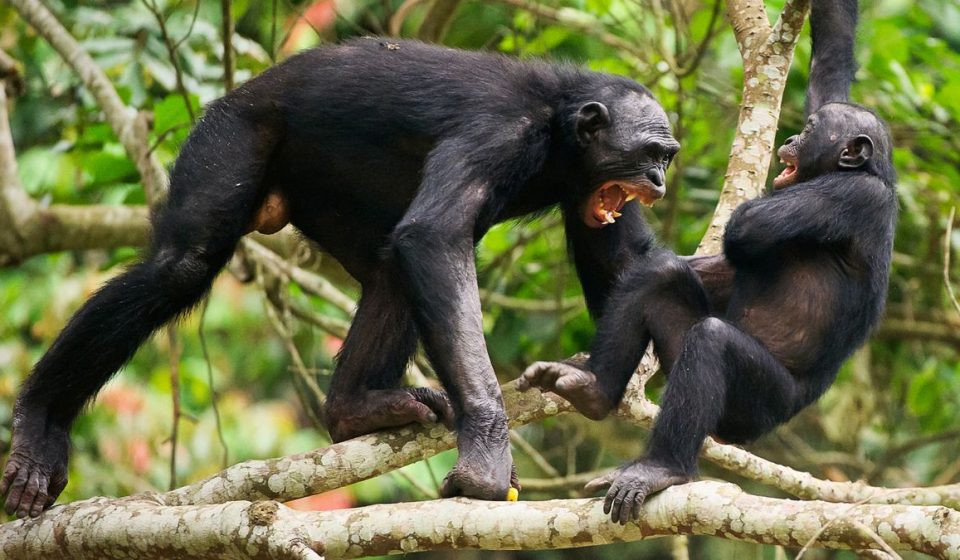
The Ngogo chimpanzee war, described by researchers as a chimpanzee “civil war,” refers to a prolonged period of conflict that occurred within a single chimpanzee community at Ngogo in Kibale National Park. The conflict involved members of the same chimpanzee community gradually separating into rival factions and engaging in aggression that eventually led to the division of the community into two independent groups. The growing separation between these factions eventually led to increasing tension and aggression.
Chimpanzees scientifically known as Pan troglodytes are among the closest living relatives of humans and are known for their complex social systems. They live in communities that cooperate in hunting, territorial defense and raising young ones. However, these societies can also experience intense aggression and competition especially among males competing for status, territory and mating opportunities. The Ngogo conflict is one of the examples of intra-community violence among chimpanzees offering insights into the origins of cooperation, conflict and group division in primates.
The chimpanzee community before the conflict
During the early years of research, the chimpanzees living at Ngogo in Kibale National Park, Uganda formed one large and stable community. Continuous research on this population began in 1995 and from 1998 to 2014 the chimpanzees lived together within a shared territory. This community was one of the largest known groups of wild Chimpanzee (Pan troglodytes). Like other chimpanzee communities, the Ngogo chimpanzees showed fission–fusion social dynamics. This means that although the chimpanzees belonged to one large community, they did not always move together as a single group. Instead, they formed smaller temporary groups known as “parties.” These parties changed frequently throughout the day as individuals moved around their shared territory.
Within the community, males and females followed different life patterns. Female chimpanzees usually left their birth group during adolescence and joined other communities while male chimpanzees remained in the same group for their entire lives. Adult males formed a dominance hierarchy where some individuals ranked higher than others. These males often cooperated in important activities such as hunting, defending territory and patrolling the boundaries of their range.
Although the Ngogo chimpanzees belonged to one group, there were smaller subgroups or clusters that existed within the community. In most years, researchers identified two to four clusters of individuals who interacted more often with each other. The two of these clusters were western cluster and the central cluster. However, these clusters were not fixed or permanent. Many chimpanzees moved between them over time. On average, about 29% of individuals changed clusters from one year to the next showing that the social structure remained flexible. Despite these clusters, the chimpanzees maintained strong connections across the entire community. Individuals from different clusters often interacted, groomed each other and traveled together.
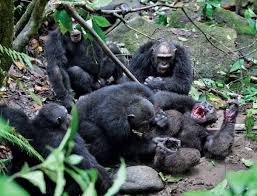
Researchers identified a few small alliances or “cliques” made up of two or three adult males who frequently stayed together over many years. One of these male alliances later became important because its members eventually formed the core of what would become the Western group after the community split. Even before the division occurred, these males were often seen together, although they still interacted with chimpanzees who would later belong to the other group.
During this period, all members of the Ngogo community shared the same territory and resources. Their home range overlapped widely, meaning individuals from different clusters used the same areas for feeding, traveling and resting. Reproduction also occurred across the entire community. Genetic studies showed that offspring were born from parents belonging to different clusters, indicating that mating was not restricted to specific subgroups. In fact, nearly half of the infants studied were born to parents from different clusters.
The course of the Ngogo permanent split
The long-standing unity of the chimpanzee community at Ngogo began to change noticeably in 2015. For nearly two decades the chimpanzees had lived as a single community with flexible social groupings. However, researchers observed a sudden shift in social behavior that eventually led to the permanent division of the group into two separate communities.
The earliest clear sign of a split occurred on 24 June 2015. Members of two previously identified social clusters, the Western cluster and the Central cluster encountered each other near the center of their territory. Normally, chimpanzees reunite easily when different parties meet, reflecting their typical fission–fusion social system. On this occasion, however, the interaction was different. Instead of joining together, the Western chimpanzees ran away while the Central chimpanzees chased them. After this encounter, the two clusters avoided each other for about six weeks, an unusually long period that had never been recorded before in this community.
Researchers studying long-term social data confirmed that the chimpanzee community was becoming more polarized. Social network analyses showed that relationships that were once spread across the entire community were gradually concentrating into two separate groups with fewer interactions between them. By 2015, the chimpanzees that once interacted frequently across clusters began to associate mostly with individuals from their own cluster. Over the next few years, these divisions became stronger and more stable. By 2018, the social structure had clearly separated into two independent groups.
As the social divide increased, aggressive interactions also became more common. In 2016, males from the Western cluster began conducting territorial patrols directed toward chimpanzees from the Central cluster. Territorial patrols are coordinated movements in which groups of male chimpanzees quietly travel along the boundaries of their territory, searching for rivals. Initially, some Central males still participated in these patrols. However, over time the patrols became exclusive to members of the Western cluster. By 2017, the Central chimpanzees had also begun patrolling against the Western group, showing that the conflict had become mutual.
During one encounter in 2017, Western chimpanzees collectively attacked and seriously injured the alpha male of the Central cluster. Interestingly, this male had previously belonged to the Western cluster before 2014. At the same time, the chimpanzees began to use different parts of the forest. Areas that were once shared gradually became divided, with each group occupying its own territory. The former center of their shared range effectively became a border between the two groups.
Reproductive patterns also changed. Before 2015, males and females from different clusters often mated, producing offspring with parents from different social clusters. After 2015, however, all new offspring were conceived by parents belonging to the same group. By 2018, the separation was complete. The original community had split permanently into two groups:
- The Western group, which included 10 adult males and 22 adult females
- The Central group, which included 30 adult males and 39 adult females
Although a few Central females occasionally joined Western chimpanzees at fruiting trees, researchers no longer observed friendly social relationships between the two groups.
After the permanent split, the relationship between the two groups escalated into violent conflict. Members of the Western group repeatedly entered the territory of the Central group during territorial patrols and launched coordinated attacks. Between 2018 and 2024, researchers documented several lethal attacks carried out by Western chimpanzees against members of the Central group. At least seven adult males from the Central group were killed during these encounters.
Beginning in 2021, the violence expanded to include infanticide. Western chimpanzees were observed attacking and killing infants belonging to the Central group. Researchers recorded 14 confirmed infant killings with additional suspected cases. On average, the Western group killed one adult male and two infants per year during this period. The true number may be higher because chimpanzees sometimes disappear in the forest without their bodies being recovered.
Causes of the community split
Scientists believe that several factors may have contributed to the breakdown of the Ngogo chimpanzee community and some of them include;
Large group size
The Ngogo chimpanzee community was unusually large, with nearly 200 individuals and more than 30 adult males. Maintaining stable relationships in such a large group may have been difficult. Competition for food and social alliances could have increased tensions within the community.
Reproductive competition
As the group grew larger, competition among males for access to females may have intensified. Researchers observed that reproductive isolation between the clusters began before the final separation, suggesting that mating competition may have played a role in deepening divisions.
Loss of key individuals
In 2014, six important members of the community including five adult males died. The loss of these individuals may have disrupted the social network and weakened connections between the clusters.
Leadership changes
A change in the alpha male also occurred around 2015, the same time when the social separation began. Leadership changes in chimpanzee communities can sometimes increase tension and aggression among males competing for dominance.
Disease outbreak
In 2017, a respiratory disease outbreak killed 25 chimpanzees, including several adult males and females. Although this occurred after the split had already begun, it may have accelerated the final separation by weakening connections between the two groups.
Similar cases like Ngogo chimpanzee war
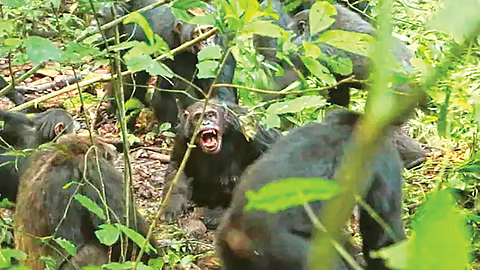
A similar case of prolonged conflict among chimpanzees was observed in Gombe Stream National Park among populations of chimpanzees. This conflict is widely known as the Gombe Chimpanzee war. The conflict occurred between two groups of chimpanzees that were once part of a single community in Gombe. Over time, the community divided into two factions known as the Kasakela group and the Kahama group. What began as a social split eventually developed into a violent territorial conflict.
From 1974 to 1978, members of the Kasakela group carried out a series of coordinated attacks against males from the Kahama group. These attacks often involved several chimpanzees working together to isolate and kill individuals from the rival group. Over the course of the conflict, most of the Kahama males were killed, and the group was eventually eliminated. The conflict was documented by primatologist Jane Goodall and her research team, who had been studying chimpanzees in Gombe for many years. Before this event, many scientists believed chimpanzees were generally peaceful animals. The violence observed during the Gombe conflict challenged that assumption and revealed that chimpanzees are capable of organized aggression toward members of neighboring groups.
What the Ngogo chimpanzee war revealed about chimpanzees
The conflict among the chimpanzees at Ngogo in Kibale National Park provided important insights into the social behavior of chimpanzees. Long-term observations showed that chimpanzee societies are highly complex and that changes in relationships within a group can lead to serious divisions and aggression.
Group identities can change over time
The Ngogo conflict showed that chimpanzee group identities are not always fixed. For many years, the chimpanzees lived as one community. However, gradual changes in social relationships caused individuals to associate more frequently with certain companions and less with others. Over time, these patterns created two distinct factions which eventually became separate groups. This demonstrates that chimpanzee communities can reorganize internally when social bonds shift.
Internal relationships influence conflict
The events at Ngogo suggested that changes in social connections and alliances can lead to divisions within a group. Researchers found that the conflict was not driven by differences such as culture or ideology, which are often associated with human conflicts. Instead, the division appeared to develop from changes in individual relationships, alliances and avoidance between members of the community.
Chimpanzees can engage in organized aggression
Chimpanzees are known to show aggression toward neighboring communities. The Ngogo conflict demonstrated that organized and lethal aggression can also occur between individuals who were once part of the same group. Members of one faction carried out multiple coordinated attacks on members of the other group, resulting in the deaths of several adult males and infants. These attacks often occurred during territorial encounters.
Male alliances play a major role in social structure
Male chimpanzees remain in their birth community for life and form strong alliances with other males. These alliances are important for maintaining dominance status, defending territory, and coordinating group activities. At Ngogo, coalitions among adult males helped shape the formation of the rival factions. Certain males maintained strong bonds with each other for many years and these relationships later formed the core of one of the new groups.
Large communities can become unstable
The Ngogo chimpanzee community was the largest known group of wild chimpanzees. The conflict suggested that very large communities may experience social pressures that make divisions more likely. As the community grew, individuals interacted with many others, and maintaining strong relationships across the entire group became more difficult. This may have contributed to the emergence of separate clusters within the community.
Insights into the evolution of conflict
Because chimpanzees are one of humanity’s closest living relatives, the Ngogo conflict provides clues about the evolutionary roots of collective violence. The events showed that organized aggression and group division can arise without cultural identities such as religion, language or ideology. This suggests that some aspects of group conflict may develop from social dynamics and competition, rather than cultural differences alone.